FREE basic specification and sourcing-requirements review
Eligible first orders may receive up to 3%
Eligibility applies to qualified business buyers and is confirmed after we review your product, quantity, destination, and sourcing requirements. Final savings depend on supplier confirmation, product type and order value.
commercial rice milling machine
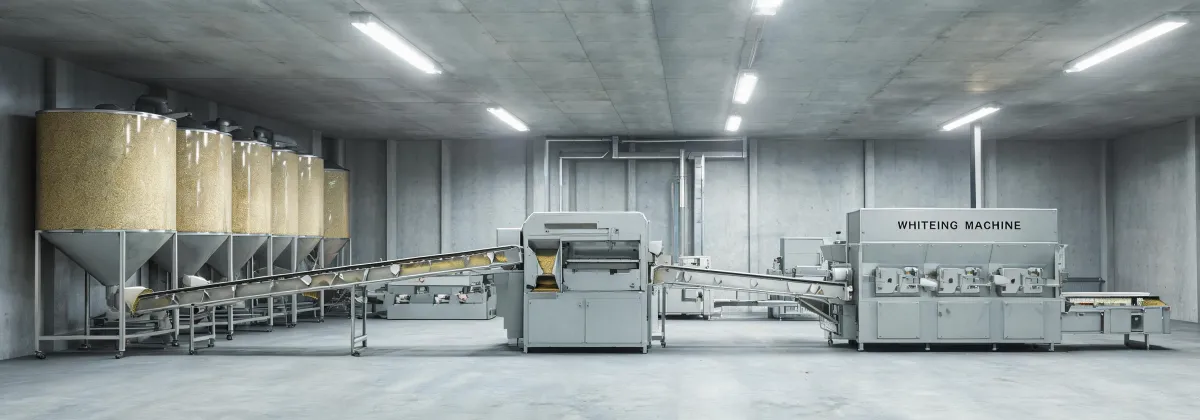
Commercial rice milling machine selection follows the grain route through the mill, not a generic food-plant label. Upstream separators and downstream graders change which whitener or compact mill envelope is comparable. Rice Milling Machine Sourcing is an independent sourcing partner: application notes below are procurement checks, not a claim that one configuration has been commissioned at a named plant. Head-rice yield and broken-grain limits must be measured on representative samples before two replies are treated as the same duty.
Material route
Operating context
Commercial lots moving from intake through hulling or whitening to grading. Confirm which stage the quoted machine occupies. A standalone whitener on brown rice is not a complete paddy line.
Material route: Equipment scope
State incoming moisture, variety and whether feedstock is paddy or brown rice. Ask the factory to restate brown-rice feed in t/h only if that is the agreed basis. Throughput without grain state is a nominal speed. Work envelope and footprint still need mill-bay confirmation.
Price exclusions
Aspiration, bran handling, loaders, installation and spare parts often sit outside a commercial rice milling machine body. Who supplies fans to the stated airflow in m³/min and static pressure in kPa should be explicit. Shipping and SAT travel remain extra until restated.
Response basis
Which head-rice yield and broken-grain limits will be measured, and on which sample, belongs in every comparable reply. FAT language should repeat that sample. This site does not certify yield. Engineering acceptance stays with the buyer and the named supplier.
Remaining inputs include three-phase supply, connected load in kW, PLC interface names, changeover between varieties, optional budget and supplier preference. Preference is a buyer selection, not a verified factory rating.
Selection factors for commercial milling duties
Decision split
What to confirm
What the source does not prove
Single machine or integrated line
Interfaces to separator, grader and packing; staffing at each stage.
A whitener sheet dated 2026-09-17 is not whole-plant output.
Nominal speed or validated output
Test moisture, variety and degree of milling on a buyer sample.
Catalog t/h without those conditions.
Machine price or installed project cost
Tooling, shipping, utilities, installation and spare parts on separate lines.
A body-only total as delivered cost.
Aspiration ownership
Fan, filter, duct and bran collection versus machine kPa requirement.
That the mill already has matching static pressure.
Duty cycle for a commercial rice milling machine is hours per shift and restart after variety changeover, not a packaging cycle time. Positioning of bran outlets and sample points is confirmed on drawings. Cooling water applies only if a cooled drive is listed. Compressed air demand applies only if pneumatic gates are listed. Adjacent equipment such as dryers is out of this site’s keyword landing scope.
Typical procurement situation (not a named customer case): a US importer comparing a compact mill for mixed brown-rice lots against a whitener that assumes an existing huller. The brief should keep husking out of the whitener total, list airflow in m³/min, and define how broken grain will be graded. Without those splits, two factory numbers are not the same commercial rice milling machine duty. Read capacity basis and air-system scope.